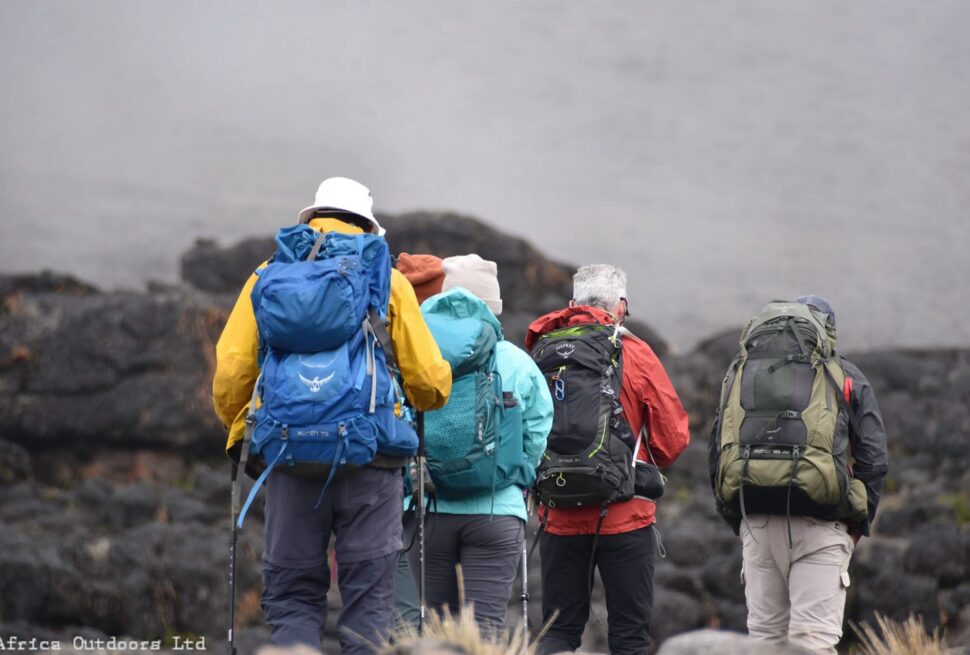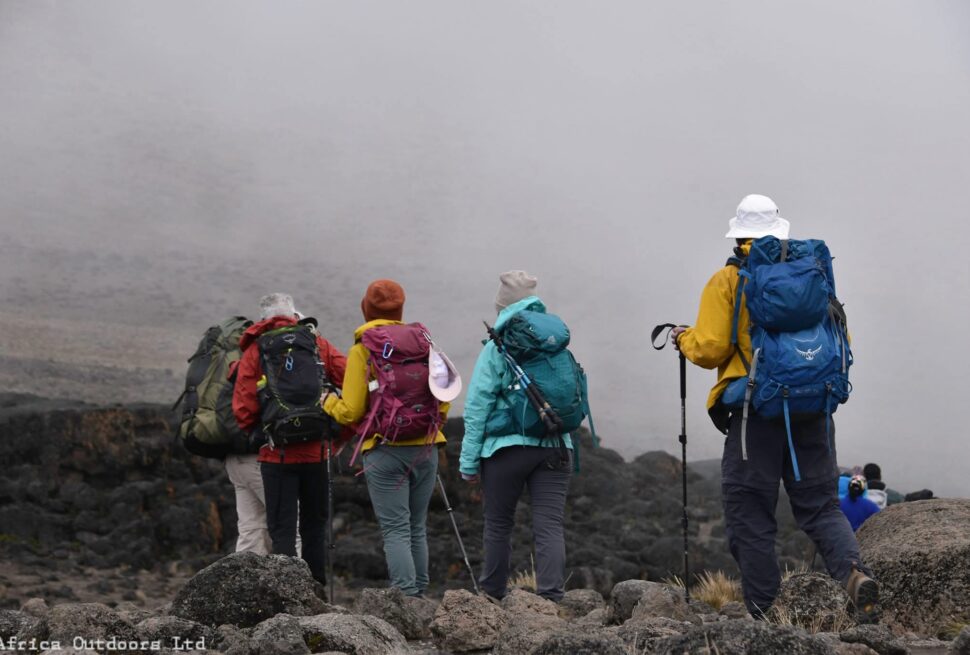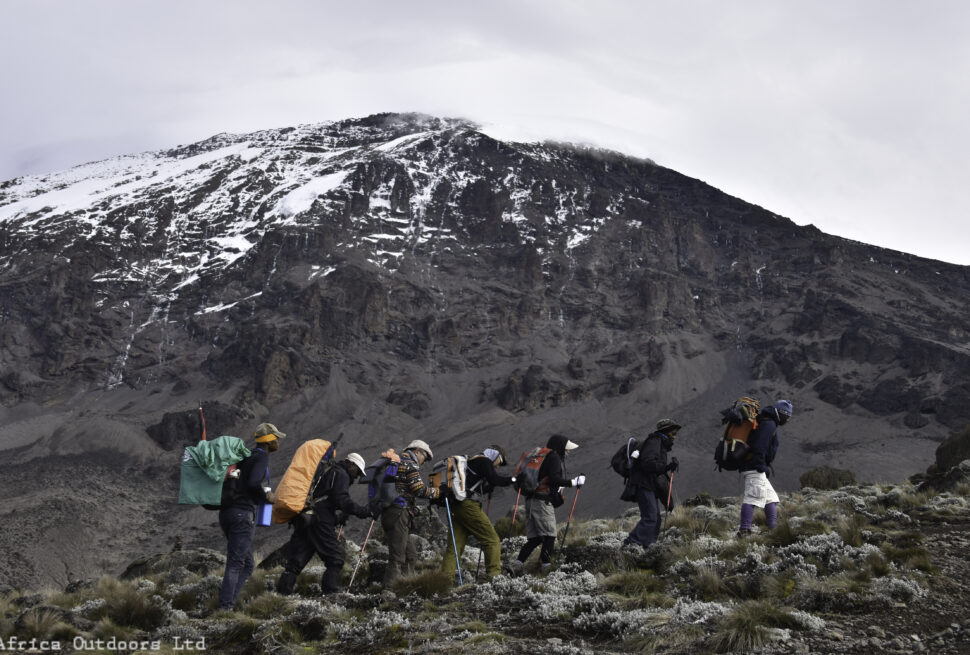
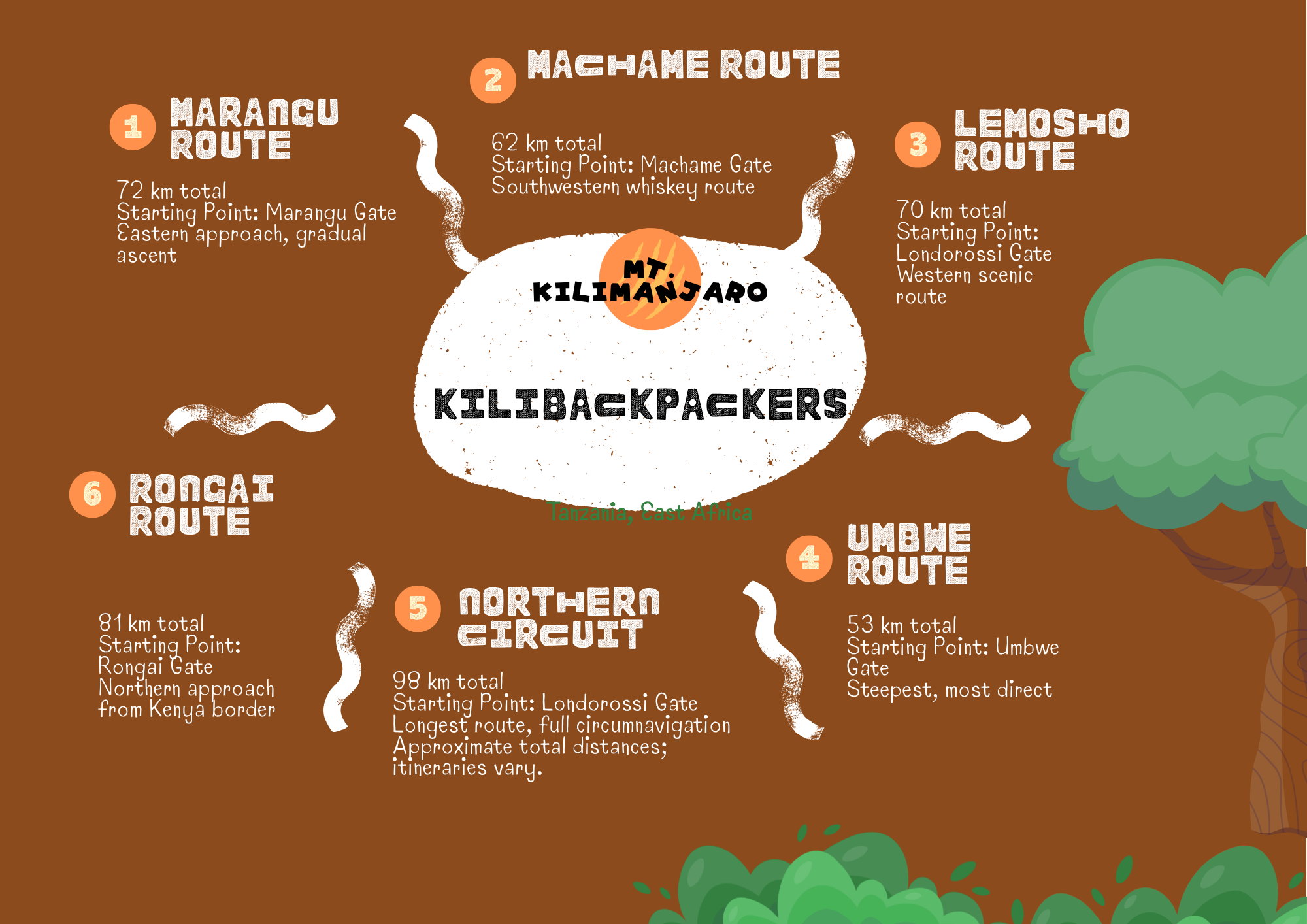
One of the most common questions from people planning to climb Mount Kilimanjaro is: “How many kilometres will I actually walk?”
The answer depends on the route and number of days you choose. A typical Kilimanjaro climb covers approximately 60–100 kilometres (37–62 miles) in total, including the ascent to Uhuru Peak and the descent.
The most popular routes are generally in the 60–75 km range, while the Northern Circuit can approach 100 km. Distances vary between itineraries because different camps, route variations, and methods of measuring the trail can produce slightly different figures.
Kilimanjaro Walking Distance by Route
| Route | Approx. Distance | Typical Duration |
|---|---|---|
| Machame Route | ~62 km | 6–7 days |
| Lemosho Route | ~70 km | 7–8 days |
| Marangu Route | ~70–72 km | 5–6 days |
| Rongai Route | ~72–73 km | 6–8 days |
| Northern Circuit | ~90–98 km | 8–10 days |
| Umbwe Route | ~50–55 km | 5–7 days |
These are approximate trail distances rather than guaranteed GPS measurements. Different sources report somewhat different figures for the same route.
How Far Do You Walk Each Day?
Although the total distance sounds large, Kilimanjaro is normally climbed over several days.
On most days, hikers walk approximately 6–12 km, depending on the route, terrain, altitude and camp location.
The summit day is completely different.
You normally begin the summit ascent around midnight or shortly afterward. The walk from high camp to Uhuru Peak is relatively short in kilometres compared with the whole trek, but the combination of darkness, steep terrain, cold temperatures and altitude makes it one of the hardest parts of the climb.
After reaching Uhuru Peak at 5,895 metres (19,341 feet), you continue descending to a much lower camp, making summit day a particularly long day on your feet.
Typical Daily Distances
A rough example might look like this:
| Trek Day | Approx. Walking |
|---|---|
| Day 1 | 5–8 km |
| Day 2 | 7–10 km |
| Day 3 | 7–12 km |
| Day 4 | 5–10 km |
| Summit Day | 12–18+ km |
| Final Descent | 8–15 km |
The exact distances depend heavily on the route and itinerary.
Why the Kilometres Are Not the Most Important Thing
When climbing Kilimanjaro, distance alone does not determine how difficult the trek will be.
A 10-kilometre day at 3,500 metres can feel considerably harder than a 15-kilometre hike at low altitude.
The main challenges are:
- High altitude
- Reduced oxygen availability
- Steep and rocky terrain
- Long summit day
- Cold temperatures
- Fatigue
- Sleeping at altitude
- Changes in weather
- Carrying a daypack for several hours
This is why Kilimanjaro should not be viewed simply as a long-distance hiking challenge.
Altitude and acclimatization are major factors.
How Many Kilometres Is the Summit Day?
Summit day is usually the most demanding day of the entire climb.
Depending on the route and camp, you may walk approximately 12–18 kilometres or more during the summit push and descent.
For example, a typical summit day involves:
High Camp → Uhuru Peak → Descend → Lower Camp
You normally start walking during the night.
The first objective is to reach the summit around sunrise. After spending a short time at or near Uhuru Peak, you begin the descent.
The descent can actually involve more kilometres than the ascent because you continue all the way down to a lower camp.
Why Summit Day Feels So Long
The physical distance is only part of the challenge.
During the summit push you may be:
- Walking for many hours
- Moving slowly
- Walking on loose volcanic rock
- Dealing with temperatures below freezing
- Breathing thinner air
- Carrying your personal daypack
- Walking before sunrise
- Feeling tired from several days of trekking
This is why a 15-kilometre summit day can feel much harder than a normal 15-kilometre hike at sea level.
Machame Route: About 62 Kilometres
The Machame Route is commonly completed in 6 or 7 days and covers roughly 60–65 km, depending on the itinerary.
It involves a mixture of rainforest, moorland, alpine desert and high-altitude volcanic terrain.
A typical 7-day Machame itinerary spreads the walking over several days, allowing climbers more time on the mountain compared with a compressed itinerary.
The route eventually joins the southern circuit toward Lava Tower, Barranco, Karanga and Barafu before the summit.
Lemosho Route: About 70 Kilometres
The Lemosho Route generally covers approximately 70 km and is usually completed in 7–8 days or longer.
It begins on the western side of Kilimanjaro and passes through the rainforest before reaching the Shira Plateau.
Because the route can be spread over more days, the daily walking distances do not necessarily have to be extreme.
The longer itinerary also provides additional time for the body to adapt to increasing altitude.
Marangu Route: About 70–72 Kilometres
The Marangu Route generally covers approximately 70–72 km on a standard itinerary.
Unlike most Kilimanjaro routes, Marangu uses mountain huts rather than tents.
The route follows the same general trail during the ascent and descent.
Although the trail has relatively gradual sections, shorter itineraries can involve long days and provide less time for acclimatization.
Rongai Route: About 72–73 Kilometres
The Rongai Route approaches Kilimanjaro from the northern side and generally covers around 70–73 km, depending on the itinerary.
The route provides a different perspective of the mountain and eventually connects with the southern circuit for the summit section.
The number of days can vary, so the daily walking distance also changes.
Northern Circuit: Around 90–100 Kilometres
The Northern Circuit is the longest major route on Kilimanjaro.
Depending on the exact itinerary and measurement used, it can cover approximately 90–100 km.
Unlike shorter routes, the Northern Circuit spends additional time traversing the northern slopes of the mountain before approaching the summit.
This means considerably more walking overall, but the distance is distributed across more days.
Does More Distance Mean a Harder Kilimanjaro Climb?
Not necessarily.
A longer route does not automatically mean a more difficult climb.
For example, walking 10 km per day for nine days can be more manageable than trying to complete a shorter route in only five days.
The number of days allows the trek to be paced differently.
A longer itinerary can provide:
- More gradual altitude gain
- More time to acclimatize
- Shorter average daily stages
- More rest opportunities
- More time to adjust to the mountain environment
This is one reason experienced hikers often look at days on the mountain, not just kilometres.
How Many Steps Do You Take on Kilimanjaro?
This varies considerably according to your stride length and terrain.
As a very rough example, if someone averages approximately 1,300–1,500 steps per kilometre, a 70-km trek could involve roughly:
91,000–105,000 steps
However, this is only an estimate.
Your actual step count can be much higher because steep terrain, rocks and short climbing steps affect stride length.
A Kilimanjaro climb can therefore involve well over 100,000 steps for some hikers.
Kilometres Are Not the Same as Elevation
There is an important difference between horizontal distance and elevation gain.
A route may cover 10 km but climb several hundred metres.
For example:
10 km on a flat trail is very different from:
10 km of steep mountain terrain at 4,000 metres.
On Kilimanjaro, the combination of distance and elevation is what makes certain days demanding.
How Fit Do You Need to Be to Walk Kilimanjaro?
You do not necessarily need to be an elite athlete.
However, you should be comfortable walking for several hours at a time and preferably be able to hike on consecutive days.
Useful training includes:
Walking and Hiking
Regular long walks are one of the best ways to prepare.
Gradually increase your distance until you are comfortable with several hours of continuous walking.
Hill Training
Include hills, stairs or inclined treadmill walking in your training.
Kilimanjaro involves substantial elevation gain and loss.
Long Weekend Hikes
If possible, practice walking on consecutive days.
For example:
Saturday: 12 km
Sunday: 10 km
This helps your body become accustomed to hiking while tired.
Strength Training
Useful exercises include:
- Squats
- Lunges
- Step-ups
- Calf raises
- Core exercises
- Glute exercises
Strong legs can make long descents and uneven terrain more manageable.
What Is More Important: Distance or Altitude?
For Kilimanjaro, altitude is one of the biggest factors.
You could be physically capable of walking 20 km at sea level but still experience altitude-related problems at 4,000–5,000 metres.
This is why pacing and acclimatization are so important.
A good Kilimanjaro strategy is:
Walk slowly + stay hydrated + allow time to acclimatize + listen to your body.
How Fast Do You Walk on Kilimanjaro?
Kilimanjaro is generally not about walking quickly.
A slow, steady pace is commonly used, especially as altitude increases.
You may hear the phrase “pole pole,” meaning “slowly, slowly” in Swahili.
Walking slowly helps conserve energy and makes it easier to maintain a sustainable pace for several hours.
The summit ascent is particularly slow because of the altitude.
Is Kilimanjaro a Long-Distance Hike?
Yes.
Depending on your route, you may walk approximately:
60–100 km in total.
But Kilimanjaro is better described as a multi-day high-altitude trek rather than simply a long-distance hike.
The combination of distance, elevation, altitude, cold and multiple days on the trail is what makes the experience unique.
Kilimanjaro Distance FAQ
How many kilometres do you walk on Kilimanjaro?
Most popular routes cover approximately 60–75 km, while the Northern Circuit can approach 100 km.
Which Kilimanjaro route is the shortest?
Umbwe is among the shortest routes by total distance, while Machame is also shorter than Lemosho and the Northern Circuit. However, route distance should not be used alone to determine difficulty.
Which Kilimanjaro route is the longest?
The Northern Circuit is the longest major route, generally covering approximately 90–100 km depending on the itinerary.
How many kilometres is the Machame Route?
The Machame Route is commonly reported at approximately 62 km, although measurements vary between itineraries.
How many kilometres is the Lemosho Route?
A typical Lemosho itinerary is approximately 70 km, although some published measurements are lower or higher depending on the route variation.
How many kilometres is the Marangu Route?
Marangu is generally around 70–72 km on a full ascent-and-descent itinerary.
How many kilometres do you walk on summit day?
A typical summit day can involve approximately 12–18 km or more, depending on the high camp, summit route and descent camp.
Can a beginner walk 70 km?
Yes, many people without previous high-altitude climbing experience complete multi-day Kilimanjaro treks. However, preparation, pacing, acclimatization and appropriate medical awareness are important.
Is Kilimanjaro harder because of the distance?
Not necessarily. Altitude, elevation gain, terrain, weather and the number of days used to complete the route can be more important than the total kilometres.
Final Takeaway
If you are planning to climb Kilimanjaro, expect to walk approximately 60–100 km in total, depending on your route.
For the most commonly used routes, a useful guide is:
- Machame: ~62 km
- Lemosho: ~70 km
- Marangu: ~70–72 km
- Rongai: ~72–73 km
- Northern Circuit: ~90–100 km
The most important thing to remember is that Kilimanjaro is not a race. The goal is to maintain a slow, comfortable pace, conserve energy and give your body enough time to adapt to altitude.
The kilometres matter, but how you distribute those kilometres over several days matters even more.