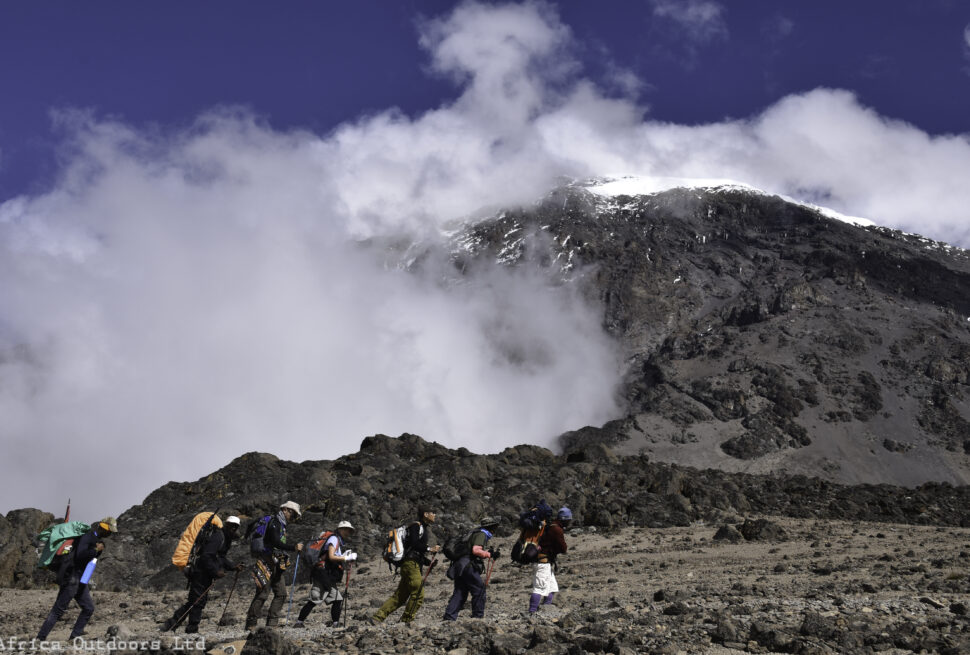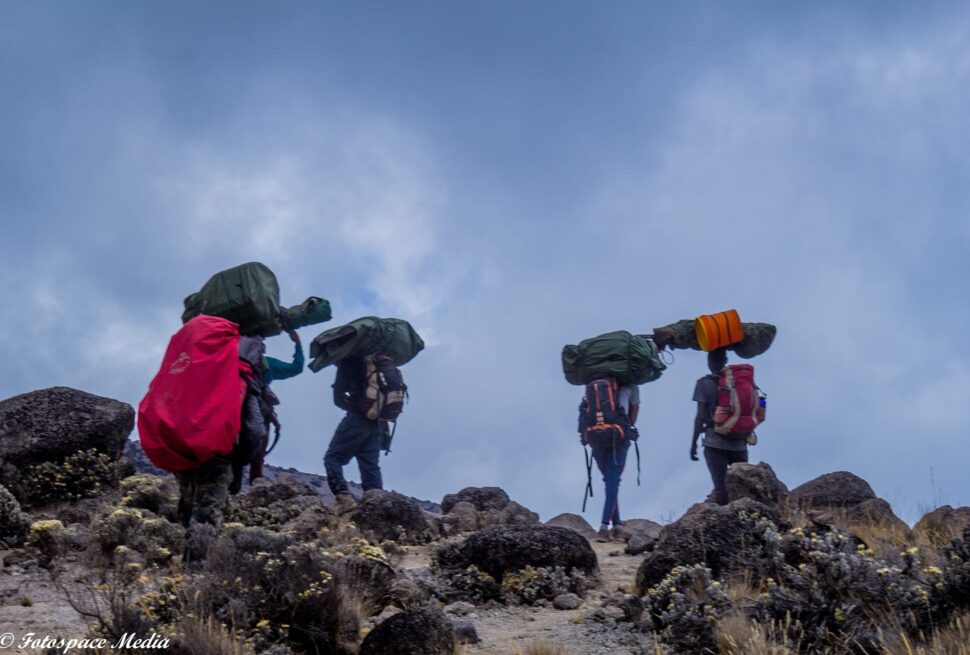
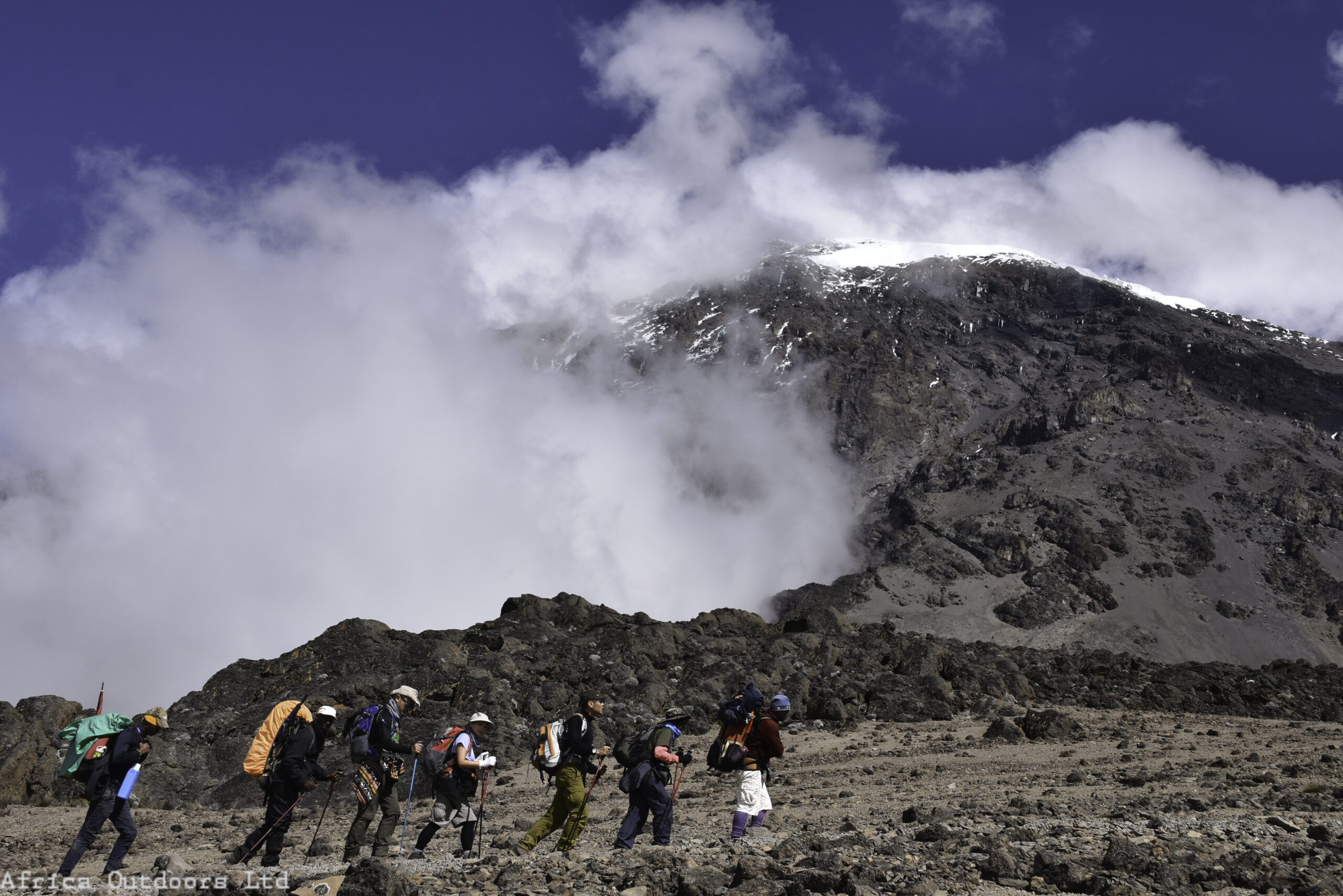
Mount Kilimanjaro is close to the equator, but the summit at Uhuru Peak (5,895 m / 19,341 ft) is a freezing alpine environment. During the typical pre-dawn summit push, climbers should be prepared for temperatures of roughly -10°C to -20°C (14°F to -4°F), with colder conditions possible. Some recent field observations put summit-push temperatures around -16°C to -20°C during the coldest months.
The important point is that there is no single “Kilimanjaro temperature.” Conditions change dramatically as you climb from the warm lower slopes to the summit.
Kilimanjaro Temperature by Altitude
| Area | Approx. altitude | Typical conditions |
|---|---|---|
| Lower slopes | 800–1,800 m | 20–30°C |
| Rainforest | 1,800–2,800 m | 10–25°C |
| Moorland | 2,800–4,000 m | 5–15°C |
| Alpine desert | 4,000–5,000 m | 0–10°C during the day |
| Barafu/Kibo high camps | ~4,700 m | Below 0°C at night |
| Stella Point | 5,739 m | Well below freezing |
| Uhuru Peak | 5,895 m | About -10°C to -20°C during summit hours |
The exact temperature varies with altitude, season, cloud, wind and time of day.
How Cold Is Uhuru Peak?
For practical planning, assume:
During the summit night
-10°C to -20°C
During particularly cold conditions
Temperatures can fall toward -20°C or below.
Windy conditions
The felt temperature can be considerably colder than the thermometer reading because of wind exposure. Recent field observations report summit winds around 30–50 km/h on exposed ridges, although stronger gusts can occur.
So if the actual temperature is -15°C, strong wind can make the conditions feel substantially colder.
Why Is Kilimanjaro So Cold Despite Being Near the Equator?
The main reason is altitude.
Kilimanjaro rises almost 5,000 metres above the surrounding landscape. Temperature generally decreases as elevation increases.
That means you can begin your trek in warm conditions and, within several days, find yourself walking through a freezing environment.
This is why Kilimanjaro is often described as taking you through several climatic zones in a single climb.
The Summit Night Is the Coldest
The coldest part of the climb is normally the summit attempt, which commonly begins around midnight or in the early morning.
You leave your high camp and climb through darkness toward:
Stella Point → Uhuru Peak
This is particularly challenging because you are combining:
- Freezing temperatures
- Strong wind
- High altitude
- Reduced oxygen
- Darkness
- Physical exertion
- Fatigue
The temperature is usually at or near its lowest shortly before sunrise.
Recent field observations place summit-push temperatures around -10°C to -20°C, depending on season and conditions. (Kilimania Adventure)
How Cold Is Barafu Camp?
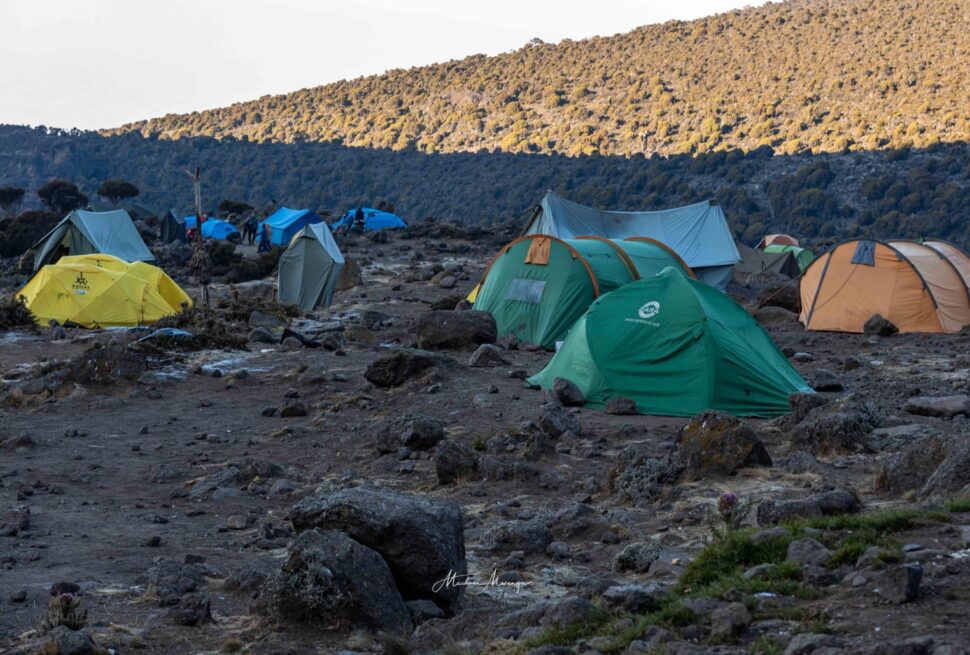
For Machame, Lemosho and some other routes, climbers may spend the night at Barafu Camp, around 4,673 m.
Barafu can already be extremely cold.
Recent field records indicate nighttime temperatures commonly reaching approximately -6°C to -12°C, depending on the season.
So when you leave camp for the summit, you are already starting in freezing conditions.
How Cold Is Kibo Hut?
On the Marangu Route, the final overnight stop is usually Kibo Hut at about 4,703 m.
Temperatures there can fall below freezing, particularly at night.
Recent observations put Kibo nighttime temperatures roughly between -5°C and -10°C during colder periods.
From Kibo, climbers begin the demanding summit push during the night.
Does Kilimanjaro Get Colder in July and August?
Yes, seasonal differences exist, although the summit is cold throughout the year.
Recent field observations indicate that July–August can be among the coldest periods at high elevations, with summit-push temperatures reaching approximately -16°C to -20°C.
However, don’t assume that climbing in January or February means the summit will be warm.
Even in the warmer periods, summit-night temperatures can remain around -10°C to -15°C or lower.
What Does -20°C Feel Like?
For someone accustomed to Kenya, Tanzania or other tropical climates, -20°C is extremely cold.
At this temperature:
- Exposed skin can become painfully cold.
- Fingers and toes lose heat quickly.
- Water can freeze.
- Batteries can lose performance.
- Wet clothing becomes a serious problem.
- Long stops become increasingly uncomfortable.
- Wind can make conditions significantly worse.
And remember that you’re not standing at sea level.
At nearly 6,000 metres, your body is already working hard because of the reduced oxygen.
What Should You Wear on Summit Night?
You should use a layering system rather than relying on one extremely thick jacket.
Base layer
- Thermal long-sleeve top
- Thermal underwear/bottoms
- Moisture-wicking material
Insulating layer
- Fleece
- Synthetic or down insulation
Outer insulation
- Warm down or synthetic insulated jacket
Outer shell
- Waterproof/windproof jacket
- Windproof trousers if necessary
Head
- Warm hat
- Balaclava
- Neck gaiter/buff
- Hood
Hands
- Thermal liner gloves
- Thick insulated gloves or mittens
- Wind/water protection
Feet
- Warm hiking boots
- Good-quality warm socks
- Spare socks
Don’t Underestimate Your Gloves
Cold hands are one of the biggest problems during summit night.
Your hands are exposed to:
- Cold temperatures
- Wind
- Trekking poles
- Metal equipment
- Long periods outdoors
For very cold conditions, mittens can be warmer than individual-finger gloves because the fingers share heat.
Carry spare hand protection as well.
Keep Your Feet Warm
Your footwear needs to accommodate warm socks without becoming too tight.
Very tight boots can restrict circulation and actually make your feet colder.
Your summit footwear should be:
- Comfortable
- Well broken-in
- Weather-resistant
- Large enough for warm socks
- Suitable for rocky, cold terrain
Your Sleeping Bag Matters Too
High camps such as Barafu and Kibo can be well below freezing at night.
A sleeping bag suitable for sub-zero mountain conditions is therefore essential.
Pay attention to the difference between:
- Comfort rating
- Limit rating
- Extreme rating
Don’t select a sleeping bag simply because the package displays an impressive-looking extreme temperature.
A good sleeping system should combine:
Sleeping bag + sleeping mat + dry sleeping clothes + appropriate tent
What Happens to Water?
Water can freeze during very cold summit conditions.
This can be particularly inconvenient if you are using a hydration bladder and exposed drinking tube.
To reduce the problem:
- Insulate your water
- Keep bottles protected
- Use an insulated sleeve where possible
- Keep the drinking tube protected from the cold
- Check your water regularly
Staying hydrated is important during the summit attempt.
Protect Your Batteries
Cold temperatures can reduce battery performance.
This can affect:
- Headlamps
- Cameras
- Phones
- GPS devices
- Power banks
Keep spare batteries and sensitive electronics protected from extreme cold where practical.
And always have backup headlamp batteries.
You don’t want your headlamp dying halfway through a night summit attempt.
Cold + Altitude Is the Real Challenge
The summit isn’t difficult simply because it is cold.
It is the combination of:
5,895 m altitude + cold + wind + physical exertion + fatigue + reduced oxygen.
This makes the summit experience considerably more demanding than simply spending a few hours outside at -15°C.
Can You Get Frostbite on Kilimanjaro?
Yes.
Frostbite is possible in sufficiently cold and windy conditions, particularly when exposed skin is not properly protected.
The areas most vulnerable are:
- Fingers
- Toes
- Nose
- Ears
- Cheeks
Protect these areas throughout the summit attempt.
Can You Get Hypothermia?
Yes.
Hypothermia occurs when your body loses heat faster than it can produce it.
Warning signs can include:
- Persistent or severe shivering
- Increasing tiredness
- Poor coordination
- Confusion
- Slurred speech
- Unusual behavior
- Increasing drowsiness
Cold combined with exhaustion should always be taken seriously.
Don’t Dress Too Warmly at the Start
It may sound strange, but sweating can become a problem.
If you begin the summit push wearing every layer you own, you may become hot and sweaty.
Later, when you stop or the wind increases, that moisture can make you much colder.
The better strategy is to adjust layers throughout the climb.
If you’re getting hot:
Remove or open a layer.
If you’re getting cold:
Add a layer immediately.
What About Sunrise?
One of the best moments of the summit climb is watching the sun rise.
Once the sun appears, direct sunlight can make conditions feel more comfortable.
But don’t expect the summit to suddenly become warm.
Uhuru Peak can remain below freezing even after sunrise, and wind can continue to make conditions unpleasant.
Kilimanjaro Cold Weather Packing List
Summit clothing
☐ Thermal base layer
☐ Thermal bottoms
☐ Fleece
☐ Warm insulated jacket
☐ Waterproof/windproof shell
☐ Warm trekking trousers
☐ Thermal leggings
☐ Warm gloves
☐ Spare gloves
☐ Warm hat
☐ Balaclava/neck gaiter
☐ Warm socks
☐ Suitable hiking boots
☐ Sunglasses
☐ Headlamp
☐ Spare batteries
High-altitude camping
☐ Sub-zero sleeping bag
☐ Good sleeping mat
☐ Dry sleeping clothes
☐ Warm socks
☐ Warm hat
Kilimanjaro Temperature: Quick Reference
| Location | Approximate temperature |
|---|---|
| Lower slopes | 20–30°C |
| Rainforest | 10–25°C |
| Moorland | 5–15°C |
| Alpine desert | 0–10°C daytime |
| Barafu Camp | Below 0°C at night |
| Kibo Hut | Around -5°C to -10°C at night in colder periods |
| Stella Point | Well below freezing |
| Uhuru Peak | Approximately -10°C to -20°C during summit hours |
| Very cold summit conditions | Around -20°C or lower |
These are planning ranges, not guaranteed forecasts. Actual temperatures can vary considerably from one summit night to another.
Final Advice
If you’re preparing for Kilimanjaro, pack for -20°C rather than packing for the average temperature.
The mountain may begin in warm tropical weather, but several days later you could be standing at 5,895 metres in temperatures around -15°C to -20°C, with strong wind and very little oxygen.
A warm insulated jacket, thermal layers, proper gloves, warm socks, suitable boots, a cold-weather sleeping bag and wind protection should be considered essential equipment, not optional extras.